Photography Tips & Guides
In-Person Sales (IPS) vs Online Galleries: Which Sells More?
IPS photography or online galleries? A balanced look at how in-person sales and online proofing compare on revenue, time and client experience for studios.
PixoProof Team4 min read
Neither model wins on its own. IPS photography tends to suit high-touch studios selling wall art and albums, while online galleries suit busy photographers who value speed and convenience. The best choice depends on your clients, your products and how much time you can give each sale.
What we mean by IPS and online galleries
In-person sales (IPS) means meeting your client after the shoot to view images together and place an order. That meeting might happen in your studio, in their home or over a video call. You guide the choices, show products and take payment on the spot.
Online galleries hand the viewing over to the client. They browse at home, pick favourites and either buy or submit selections. You step back and respond to what they choose.
Both models are legitimate. Plenty of studios run a hybrid.
The case for IPS photography
The strength of IPS is guidance. Most clients have never bought wall art before, and they struggle to picture a 40-inch canvas from a phone screen. When you are in the room, you can show scale, finishes and groupings.
IPS also creates a decision moment. The client has set aside time, they are emotionally engaged and the order happens before life gets in the way. There is no gallery left unopened for weeks.
Other advantages include:
You can answer objections in real time
You learn what your clients actually value
Albums and collections are easier to explain face to face
The experience itself feels premium and memorable
The case for online galleries
Online galleries respect your client's time. Busy parents of a newborn may not want another appointment. They would rather browse at 11pm with a cup of tea and a sleeping baby.
They also respect yours. An IPS session might take an hour or more, plus preparation and follow-up. Online delivery scales without adding hours to your week.
Other advantages include:
Clients can share the gallery with a partner who missed the shoot
Decisions happen without pressure, which some clients prefer
Lower overheads, since you need no viewing room or sample products
Easier for destination or interstate clients
Side-by-side comparison
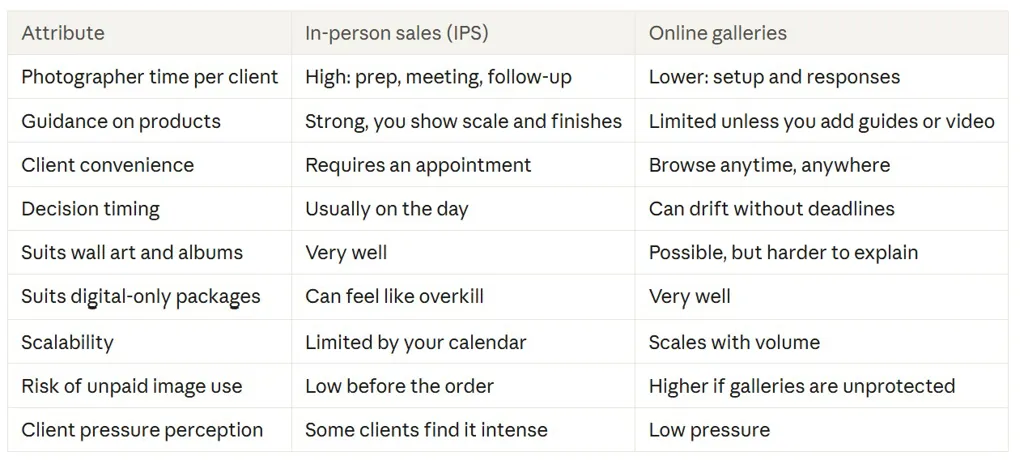
Where online galleries quietly lose money
The weak spots of online galleries are fixable, but you have to see them first. The biggest is the gallery that never gets opened. No meeting means no deadline, and no deadline means "I'll look at it this weekend" for three months.
The second is the screenshot. A client who can grab five favourites for free has less reason to buy them. Most are not being malicious, they just do what their phone makes easy.
The third is the vague selection. "We loved the one near the tree" sent by text is not an order. Without clear structure, you end up chasing details instead of fulfilling sales.
Where IPS can trip you up
IPS has its own failure points. If your pricing feels unclear or the session feels pushy, clients can leave uncomfortable. That memory follows you into referrals.
It also relies heavily on your sales confidence. Some photographers love the conversation, others dread it. Forcing yourself into a model that drains you is rarely sustainable.
Finally, IPS can struggle with clients who need to consult someone not in the room. A "let me check with my husband" moment can stall the whole sale.
Choosing a model, or building a hybrid
Start with your products. If most of your revenue comes from albums and wall art, IPS deserves a serious look. If you mostly sell digital collections, a well-run online gallery may be all you need.
Then consider your clients. Newborn and maternity families often value home convenience. Wedding couples might enjoy a celebratory viewing night.
A hybrid often works well. For example:
Deliver a protected online gallery for favouriting and shortlisting
Hold a short ordering session, in person or on video, for the final choices
Use the online gallery for digital add-ons after the meeting
Say you shoot 60 family sessions a year. You might offer IPS to clients who book wall art packages and online-only to digital clients. That keeps your calendar sane while still guiding the buyers who need it.
Making online galleries work harder
If you lean online, the goal is to borrow the best parts of IPS: structure, timing and protection. That is the gap PixoProof is built to close.
Clients make selections in the PixoProof mobile app for iOS and Android, where screenshots and screen recording are blocked. Every attempt is reported to your dashboard and by email. You decide whether clients also get web access and what they can do there, including downloads.
Selection limits create a natural decision point. Once a client reaches their limit, the rest of the gallery locks and they are ready to submit. The live activity feed and analytics funnel show where clients stall. You can follow up at the right moment instead of guessing.
Clients can also leave notes on individual photos, which brings back some of the conversation IPS offers.
The bottom line
The right model is the one that fits your products, your clients and your energy. Whichever you choose, give clients structure, protect your images and make the decision easy.
Start free at pixoproof.com. Your Photos. Your Rules.